
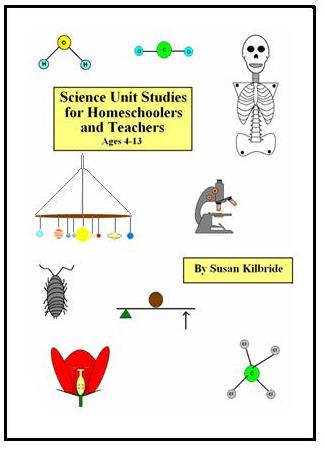
If you are a homeschooler or teacher who is looking for fun ideas on how to teach science, then this book is for you! Its hands-on approach is designed to capture students’ interest and promote a love of science and learning. The first ten chapters are for younger children ages 4-7, while the second ten chapters are for children ages 8-13. Each chapter is filled with fun science activities that teach a particular science concept. The activities are designed to use common household items, so you won’t need to buy lots of expensive scientific equipment or chemicals. This book is sure to get your kids loving science!
Great news! There is now a new edition that sells for $16.95 (the old price was $24.95). You can purchase it at:
Click here for a Free Plant Unit study from Science Unit Studies for Homeschoolers and Teachers: Plant Unit
Click here for a Free Atoms and Molecules Unit study from Science Unit Studies for Homeschoolers and Teachers: Molecules Unit
Here’s what folks are saying about Science Unit Studies for Homeschoolers and Teachers:
Finally! Here is a book written in a way that any homeschooling parent, regardless of educational background, can easily follow. This book also makes it easy to teach Science to children of different ages, at the same time! My favorite part is that the lessons do not require a lot of planning or expense. Two words characterize each lesson: fun and easy! Thanks, Ms. Killbride!
-Brad M. McGehee-
Wonderful manual, Sue Kilbride! Step by step directions, materials lists (that are readily available in our semi-rural area), extra activities – it’s all in here. It inspired me to start a science club for my son and his friends – no small feat for me. The labs are clearly laid out and easy to execute. We are very excited to share this find with our friends!
-S. Mashburn-
This collection of fun science lessons and activities are designed to offer hands on experiments that will satisfy the curious nature of children, while making it easier for parents to teach science. Kids love to pour, measure, taste, alter, and explore their environment. If you can direct their experimentation to teach a concept, then you are more likely to help them remember the material.
–Ann Davis of Homeschool Buzz-
If you’re looking for a science unit study homeschool program that is easy to use and is comprehensive and worth using, then you should check out Science Unit Studies for Homeschoolers and Teachers. I recently read through the book and really liked what I saw.
–Heidi Johnson of Homeschool-how-to.com-
If you are looking for quality science units, but simply don’t have the time to put a unit together, Susan’s book is perfect for you. If you want to supplement your existing science program, I definitely recommend taking a close look at the book. Those of you who might be a little scared of trying to put together your own science lessons for fear you might get something wrong, fear no more. . . .
–Jackie from Quaint Scribbles-
. . .the conversational style and logical, easy-to-follow instructions certainly make this a recommended and useful tool for any parent; especially those who may be uncomfortable or unfamiliar with teaching science.
-Jeanie Frias of California Homeschooler-
Susan’s book is full of so many activities that one would have a very full study of general science over the course of a school year if every activity were completed. I teach a General Science class at a local homeschool co-op and I am implementing a lot of the activities in this book into my class this year. There are even short quizzes (complete with answer keys) provided for the older student unit studies. The quizzes are multiple choice in format and cover the main points students should glean from each unit. I highly recommend this book for any science teacher or student. It really makes the teaching of science quite simple and fun. Overall I give Susan’s book 5+ stars.
-Heart of the Matter Online–
I think Science Unit Studies for Homeschoolers and Teachers is a good value and provides a lot of fun, hands-on science for homeschoolers.
–Courtney Larson, The Old Schoolhouse® Magazine-
The wealth of information included therein is amazing and the material is novice friendly. I would definitely recommend Science Unit Studies for Homeschoolers and Teachers.
Bridgette Taylor with Hearts at Home Curriculum
Disclosure: I have now become an Amazon Affiliate so if you purchase these books after clicking on their links, I will earn a small percentage of the profits. I became an affiliate after some of my readers suggested it. (You can read the comments about it below.)


